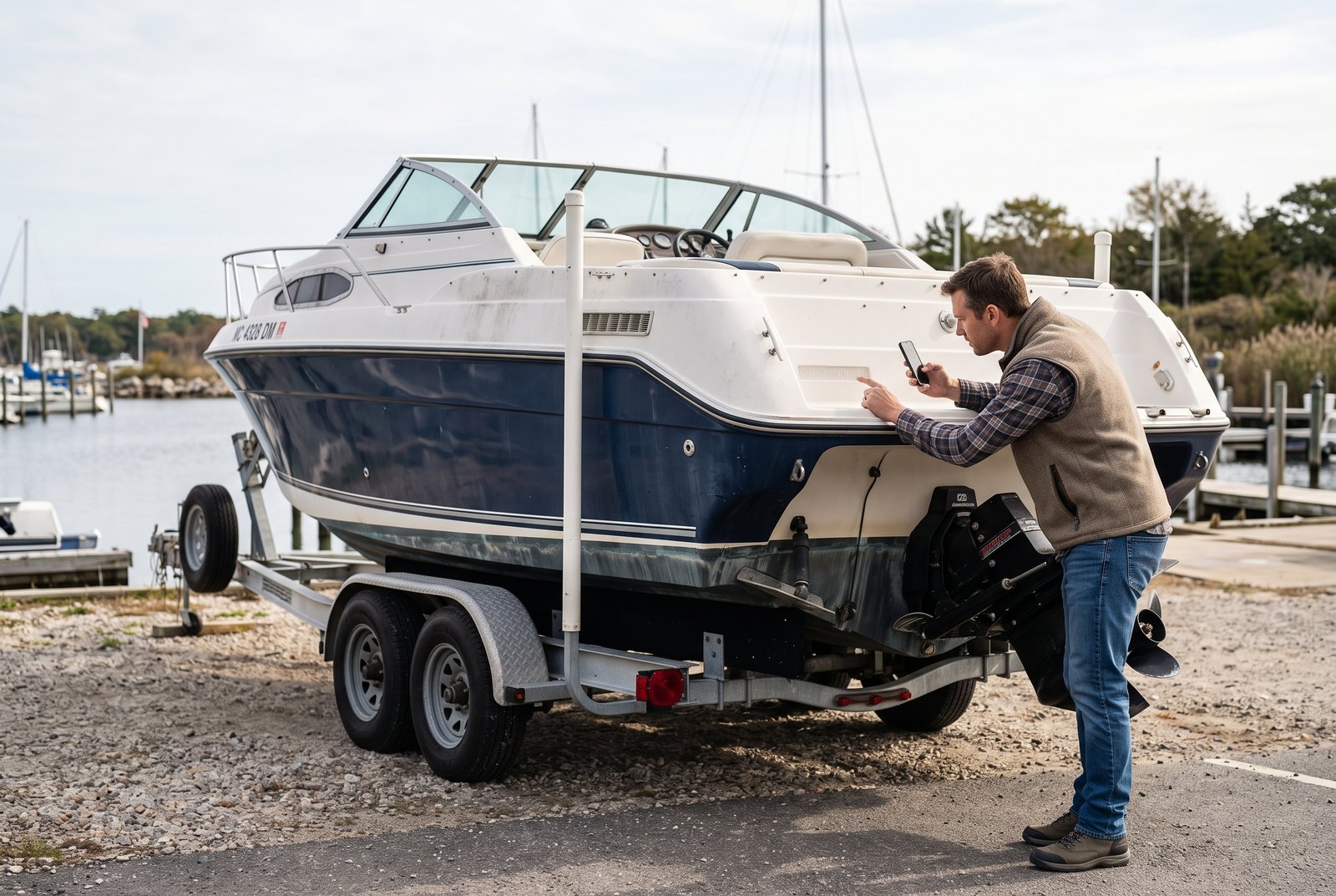
Buying a used boat can save you money, but it can also expose you to hidden damage, registration problems, theft concerns, or expensive repairs. Before you pay a seller, take time to check the boat’s history and verify that its identification details match the paperwork.
A boat history check can help you investigate a vessel’s identity, available records, and potential warning signs before making a purchase. The process typically starts with the Hull Identification Number (HIN), followed by title and registration checks, available history records, and an in-person inspection.
In this guide, you’ll learn how to check a boat’s history, where to look for important records, what a HIN can tell you, and which checks to complete before buying a used boat in the United States.
Quick Answer: How Do You Check a Boat’s History?
To check a used boat’s history before buying:
- Find the boat’s Hull Identification Number (HIN).
- Verify that the HIN matches the boat’s paperwork and physical markings.
- Use a HIN decoder to check available identification and manufacturer details.
- Review the boat’s title, registration, and ownership documents.
- Search relevant Coast Guard records if the vessel is federally documented.
- Investigate available theft, recall, damage, and other history records.
- Have a qualified marine professional inspect the boat before you buy it.
A boat history report can help organize available information, but no report or database is guaranteed to contain every event in a vessel’s past. Always combine record checks with document verification and a physical inspection.
1. Find the Boat’s Hull Identification Number (HIN)
The first step in a boat history check is identifying the vessel correctly.
A Hull Identification Number, commonly called a HIN, is a unique identifier assigned to a boat. It serves a similar identification purpose to a Vehicle Identification Number (VIN) on a car.
Many U.S. recreational boats manufactured or imported on or after November 1, 1972, are required to have a HIN under applicable federal regulations.
On many boats, the HIN is located on the upper starboard side of the transom—the right rear side when facing forward from inside the boat. Its location can vary by vessel design and applicable requirements.
What should you check?
Before searching the HIN:
- Photograph the number so you can enter it accurately.
- Compare it with the number printed on the title or registration documents.
- Look for signs that the number has been altered, removed, damaged, or replaced.
- Confirm that the number corresponds to the boat being advertised.
- Ask the seller to explain any mismatch before proceeding.
Even a single incorrect character can lead you to information for a different vessel. If the number appears suspicious, contact the relevant state boating authority or manufacturer for guidance rather than relying on an online lookup alone.
Helpful next step: Use the US Auto History HIN decoder to investigate the boat’s identification details. A HIN decoder helps with identification; it should not be treated as proof of ownership or a complete history report.
2. Check What the HIN Can Tell You
A HIN can help identify a boat and may provide information associated with its manufacturer and production details.
Depending on the format and available data, decoding the HIN may help you understand:
- The manufacturer or builder associated with the number
- Certain production or model-year information
- Whether the number appears consistent with the expected format
- Whether the boat’s identifying details deserve further verification
However, a HIN does not automatically reveal every previous owner, accident, repair, insurance claim, theft report, or title issue.
For example, a boat may have been repaired after a collision without the event appearing in a database available to you. Similarly, a valid-looking HIN does not prove that the seller legally owns the vessel.
Use the HIN as the starting point for further research, not as the only check you perform.
3. Review the Boat’s Title and Registration
A boat’s paperwork is one of the most important parts of the buying process.
Requirements vary by state and vessel type. Some boats are titled and registered through a state agency, while certain eligible vessels are documented with the U.S. Coast Guard. A boat may also have different requirements depending on its size, use, and location.
Ask the seller for the relevant title, registration, or federal documentation before agreeing to buy.
Check the following details:
- HIN: Does the identification number match the physical boat?
- Owner information: Does the seller’s identity match the documentation, or can the seller establish legal authority to sell?
- Vessel description: Do the make, model, year, and other available details match?
- Title status: Are there title brands or other issues that require explanation?
- Transfer requirements: What documents and signatures are required to transfer ownership in the relevant state?
- Outstanding claims: Are there mortgages, liens, or other recorded interests that need to be resolved?
Do not assume that a bill of sale alone resolves every ownership or title issue. Confirm the transfer requirements with the appropriate state agency or, for federally documented vessels, the U.S. Coast Guard’s National Vessel Documentation Center.
What if the boat has no title?
Do not immediately assume that a boat without a title is stolen or that the sale is necessarily illegal. Titling requirements differ by jurisdiction and vessel circumstances.
Instead, contact the relevant state boating or motor-vehicle agency to establish what documents are required. Ask the seller to explain the boat’s registration and ownership history, and do not pay until you understand how the transfer can be completed legally.
4. Search Available Boat History Records
A boat history report can help you investigate information that may not be obvious from a listing or a brief conversation with the seller.
Depending on the vessel and the sources available, a report or separate records search may help you investigate:
- Identification and manufacturer information
- Available title or registration details
- Certain reported theft or damage information
- Available recall or safety information
- Other vessel-specific records supplied by the underlying sources
The information available varies. Not every boat has the same reporting history, and some records are held by separate state or federal agencies.
For U.S. Coast Guard-documented vessels, you can search the Coast Guard’s Port State Information Exchange (PSIX) database:
https://cgmix.uscg.mil/PSIX/PSIXSEARCH.ASPX
The Coast Guard also provides information about documentation records and obtaining an abstract of title:
An abstract of title may be useful when investigating recorded ownership transfers, mortgages, or liens for a federally documented vessel. State-titled boats may require separate state-level checks.
Important: A search that returns no records does not prove that a boat has a clean history. It may mean that the information is unavailable, is held by another agency, or was never reported to the source being searched.
5. Look for Signs of Previous Damage or Major Repairs
A boat can look attractive in photographs while having hidden structural or mechanical problems.
Previous damage may result from collisions, grounding, storms, water intrusion, or improper storage. Repairs can be performed professionally, but buyers should understand the nature and quality of significant work before committing to a purchase.
During your inspection, pay attention to:
- Cracks, unusual repairs, or inconsistent finishes around the hull
- Signs of water intrusion or persistent moisture
- Soft spots or unusual movement in the deck or floor
- Corrosion around fittings and hardware
- Unusual odors, mold, or evidence of prolonged water exposure
- Poorly aligned panels or components that may indicate previous repairs
- Engine corrosion, leaks, or signs of inadequate maintenance
These observations are warning signs, not definitive proof of a particular event. Some issues may be cosmetic, while others can indicate expensive structural or mechanical problems.
Ask the seller for repair invoices, maintenance records, insurance documentation where available, and details of any known collision or grounding incidents.
For a significant purchase, arrange an independent marine survey. A surveyor can evaluate the vessel’s condition and identify issues that a general buyer may miss.
6. Check for Theft and Identity Problems
Before buying a used boat, make reasonable efforts to establish that the vessel is the one described in the paperwork and that the seller has the right to sell it.
Warning signs include:
- A HIN that differs from the title or registration
- Scratches, grinding, or other suspicious alterations around identification markings
- Missing or inconsistent ownership documents
- A seller who refuses reasonable identity or paperwork checks
- A price that seems unusually low without a convincing explanation
- Conflicting details about the boat’s manufacturer, year, or ownership
Ask the relevant authorities about available theft-record checks. Depending on the circumstances, you may also be able to consult appropriate law-enforcement resources or other databases.
A negative theft search is not an absolute guarantee. Records can be incomplete or delayed, and not every database covers every vessel.
If you suspect that the boat may be stolen or that an identification number has been tampered with, stop the transaction and contact the appropriate authorities.
7. Verify Recalls and Safety Information
A used boat may be subject to a safety recall or may have components that require attention.
Check for available recall information using the manufacturer, model, and relevant identification details. Depending on the boat and equipment involved, consult the manufacturer and appropriate official safety resources.
Also ask the seller whether any recall repairs have been completed and request supporting documentation when available.
A recall search is only one part of a safety check. It does not establish that the boat is mechanically sound or that all safety equipment is present and working.
Before using the vessel, make sure its condition and required safety equipment meet the applicable rules for its type and intended use.
8. Review the Engine and Maintenance History
A boat’s condition depends on more than its hull. Engine problems and neglected maintenance can turn an apparently affordable purchase into an expensive project.
Ask for service records showing, where applicable:
- Routine engine maintenance
- Oil and filter changes
- Cooling-system service
- Repairs to the propulsion system
- Winterization and storage procedures
- Electrical work
- Major engine or component replacements
Compare the records with the seller’s description of the boat’s age, usage, and condition.
If maintenance records are missing, that does not automatically mean the boat is defective. It does mean you have less evidence about how it was maintained.
Arrange a mechanical inspection appropriate to the engine and propulsion system. Where suitable, a professional may recommend additional tests or a sea trial under safe conditions.
Do not rely on an engine starting successfully during a brief demonstration as proof that it is in good condition.
9. Arrange a Marine Survey Before Paying
Online records help you investigate the boat’s past, but they cannot replace an inspection of the actual vessel.
A qualified marine surveyor can assess relevant aspects of the boat’s condition, including the hull, deck, systems, and other components within the scope of the survey. Engine-specific testing may require a separate specialist.
Before the survey, ask what it will cover, whether a sea trial is included, and whether additional testing is recommended.
The survey may identify issues that justify:
- Requesting repairs before the sale
- Negotiating a lower price
- Asking for further documentation
- Obtaining specialist advice
- Walking away from the purchase
The right inspection depends on the boat’s age, construction, value, and intended use. For an older or expensive vessel, spending money on professional evaluation may help you avoid a much larger unexpected expense.
10. Use a Boat History Report Alongside Official Checks
A boat history report can make the research process easier by bringing together available information from relevant sources. It can be a useful step before investing time and money in a physical inspection.
However, no report should be treated as a complete record of everything that has happened to a boat.
For the best results, combine several checks:
- Decode and verify the HIN.
- Review the title, registration, or federal documentation.
- Investigate available history and theft records.
- Check relevant recalls and safety information.
- Review maintenance and repair documents.
- Arrange a professional inspection before completing the purchase.
You can start by checking the boat’s identification with the US Auto History HIN decoder and exploring the available information through the US Auto History boat history report.
[US Auto History boat history report]
Review the report’s actual findings and coverage before relying on it. If important questions remain unanswered, follow up with the relevant state agency, manufacturer, Coast Guard documentation service, or marine professional.
Boat History Check: What Should You Verify?
Use this checklist before buying a used boat.
- The HIN is legible and matches the available paperwork.
- The seller can establish the legal right to sell the boat.
- The title, registration, or federal documentation has been reviewed.
- Any title brands or ownership discrepancies have been investigated.
- Available theft and safety records have been checked.
- The seller has explained known damage and major repairs.
- Maintenance and engine records have been reviewed where available.
- A marine survey or appropriate inspection has been arranged.
- Transfer requirements have been confirmed with the relevant authority.
- The price and purchase agreement reflect the boat’s verified condition.
If any important item cannot be verified, pause before paying. A seller’s willingness to answer reasonable questions and provide documents is an important part of the buying process.
Frequently Asked Questions About Boat History Reports
Can I check a boat’s history by HIN?
Yes, the HIN is an important starting point for a boat history check. A HIN decoder can help identify the vessel and interpret available identification details. Additional searches may be needed for title, registration, theft, damage, and other records.
Is there a free boat history check?
You can perform some checks for free, including certain identification lookups and searches of available government records. However, free sources may cover only specific types of information, and no single free search is guaranteed to provide a complete history for every boat.
What does a boat history report show?
The information depends on the boat and the report provider’s data sources. Available information may include identification details and certain reported history records. Coverage is not universal, so check the report’s stated scope and investigate important gaps separately.
Can a boat history report tell me if a boat was in an accident?
It may contain reported damage information when that information is available from its sources. However, unreported accidents, repairs, and other events may not appear. Always inspect the vessel and request repair documentation when appropriate.
How do I check whether a boat is stolen?
Start by verifying the HIN and comparing it with the vessel’s documents. Investigate available theft records and contact the appropriate authorities if you find discrepancies or have concerns. No single search can guarantee that a vessel is not stolen.
How do I check for liens on a boat?
The correct process depends on how the vessel is titled or documented. For a federally documented vessel, you can ask the U.S. Coast Guard’s National Vessel Documentation Center about obtaining an abstract of title. For state-titled vessels, check with the relevant state agency and seek appropriate legal or professional advice if a potential lien is identified.
Does a boat need a title in every U.S. state?
Requirements vary by state and vessel type. Do not assume that every boat follows the same titling rules. Check the relevant state boating or registration agency to determine what documentation is required for the specific vessel.
Should I buy a boat if its history report is clean?
A report with no adverse findings is not proof that a boat has never been damaged or has no outstanding issues. Confirm the documents, investigate any gaps, and arrange an appropriate inspection before making your decision.
Final Thoughts
Checking a boat’s history before buying helps you make a more informed decision and identify questions that deserve further investigation.
Start with the HIN, verify the ownership documents, review available records, and inspect the boat’s physical condition. Use a boat history report as one part of that process—not as a substitute for official documentation or a professional marine survey.
Before you buy, start with the boat’s HIN. Use the US Auto History HIN decoder to investigate the vessel’s identifying details, then review the available boat history report information and follow up on anything that needs verification.
[US Auto History boat history report]
Official resources
- U.S. Coast Guard — HIN Validation and Verification Guidelines
- U.S. Coast Guard — Port State Information Exchange vessel search
- U.S. Coast Guard — National Vessel Documentation Center
Information in this guide is general and educational. Record availability and vessel requirements vary. Verify important legal, title, and safety questions with the appropriate authority or qualified professional.